
Manatee Juvenile Release Paths
The Manatee Regional Juvenile Detention Center is a hardware-secure facility operated by the Florida Department of Juvenile Justice. It holds youth while they await a court date, adjudication, disposition, or a placement decision. Adjudication is the juvenile court’s decision on whether the allegation was proved. Disposition is the court’s plan or sanction after that decision. Neither term should be replaced with adult conviction or sentence language.
A youth may leave secure detention to return to a parent or guardian. Another youth may move to home detention, probation, aftercare, or a residential commitment program. Home detention is a supervised community status, not confinement at the secure center. Residential commitment is a move to a DJJ program and is not a community release. The exact route comes from DJJ and the juvenile court order, not from a public adult booking status.
| Departure from secure detention | Where the youth goes | Confirm through |
|---|---|---|
| Release to parent or guardian | Approved home or caregiver | DJJ, facility staff, and juvenile court order |
| Home detention or probation | Community under stated conditions | DJJ probation and authorized case contacts |
| Residential commitment | DJJ residential program | DJJ placement staff and disposition order |
| Aftercare or service transition | Community services after placement | Assigned juvenile probation or intervention office |
Confirm Manatee Juvenile Release
The adult MCSO Arrest Inquiry is not the release locator for this center. It covers adult county-jail bookings and recent adult releases. FDC’s adult prison and supervision searches also do not replace DJJ records. Using those systems for a youth can produce no result while saying nothing about secure detention, court status, community supervision, or placement.
- Determine whether the requester is a parent, guardian, attorney, authorized representative, victim with notice rights, or another person allowed to receive information.
- Contact the Manatee Regional Juvenile Detention Center or the youth’s assigned DJJ case contact. Give only the identifying facts needed for the authorized inquiry.
- Ask whether the youth remains in secure detention, was returned to an approved caregiver, entered community supervision, or moved to residential placement.
- Use the juvenile court through an authorized channel to confirm the detention, release, or disposition order. Public web access may be restricted.
- For community follow-up, contact Manatee County DJJ Probation and Community Intervention rather than an adult probation office.
The Florida DJJ detention-centers directory identifies the state’s secure detention system.
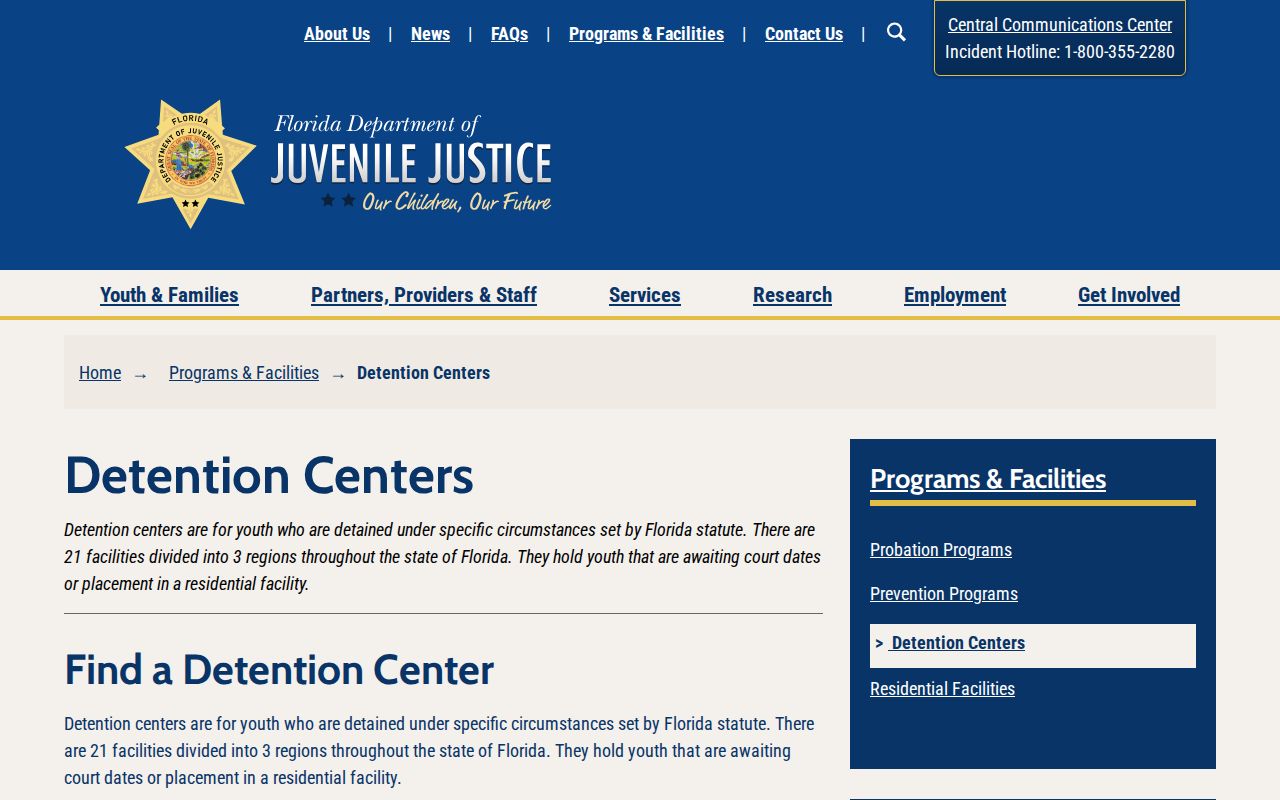
The directory is a facility-routing source. It is not a public roster of youth or an unrestricted release database.
Manatee Juvenile Record Privacy
Florida section 985.04 generally makes juvenile information confidential, subject to defined exceptions. Some facts involving youth charged with adult-equivalent felonies or transferred to adult court may be treated differently. Even then, public access does not turn the juvenile center into an adult jail portal, and an agency may maintain a narrow online-photo practice.
Authorized access depends on the requester’s legal role and the record sought. A parent or guardian may need to verify identity and relationship. An attorney or representative may need authorization. Victim notice rights follow their own legal channels. A member of the public may receive little or no case-specific information. Staff should not be pressed to disclose protected details through an ordinary information call.
- Secure detention
- Short-term, hardware-secure DJJ custody while a youth awaits court action or placement.
- Home detention
- Court-ordered community restriction and monitoring outside the secure center.
- Probation
- Community supervision under DJJ conditions and an assigned officer.
- Residential commitment
- Court-ordered placement in a DJJ residential program, which continues custody or control.
- Aftercare
- Services and supervision that may follow a residential program.
A sealed, confidential, or role-restricted record may not appear in a public court search. That absence does not prove a release date, case outcome, or lack of placement. The authorized court record and DJJ case information control.
Note: Juvenile confidentiality protects case-specific facts even when the facility’s address, operator, and general program role are public.
Manatee Juvenile Release Contacts
Direct secure-custody questions to the Manatee Regional Juvenile Detention Center. The official facility page is the source for its current contact information and regional role. A caller should be ready to explain the legal relationship to the youth and should expect identity checks or limits on what staff can confirm.
Manatee Regional Juvenile Detention Center1803 Fifth Street West
Bradenton, FL 34205
Phone: 941-741-3023
Fax: 941-741-3061
Operator: Florida Department of Juvenile Justice
The official Manatee facility page identifies the center, contact channels, and service area.
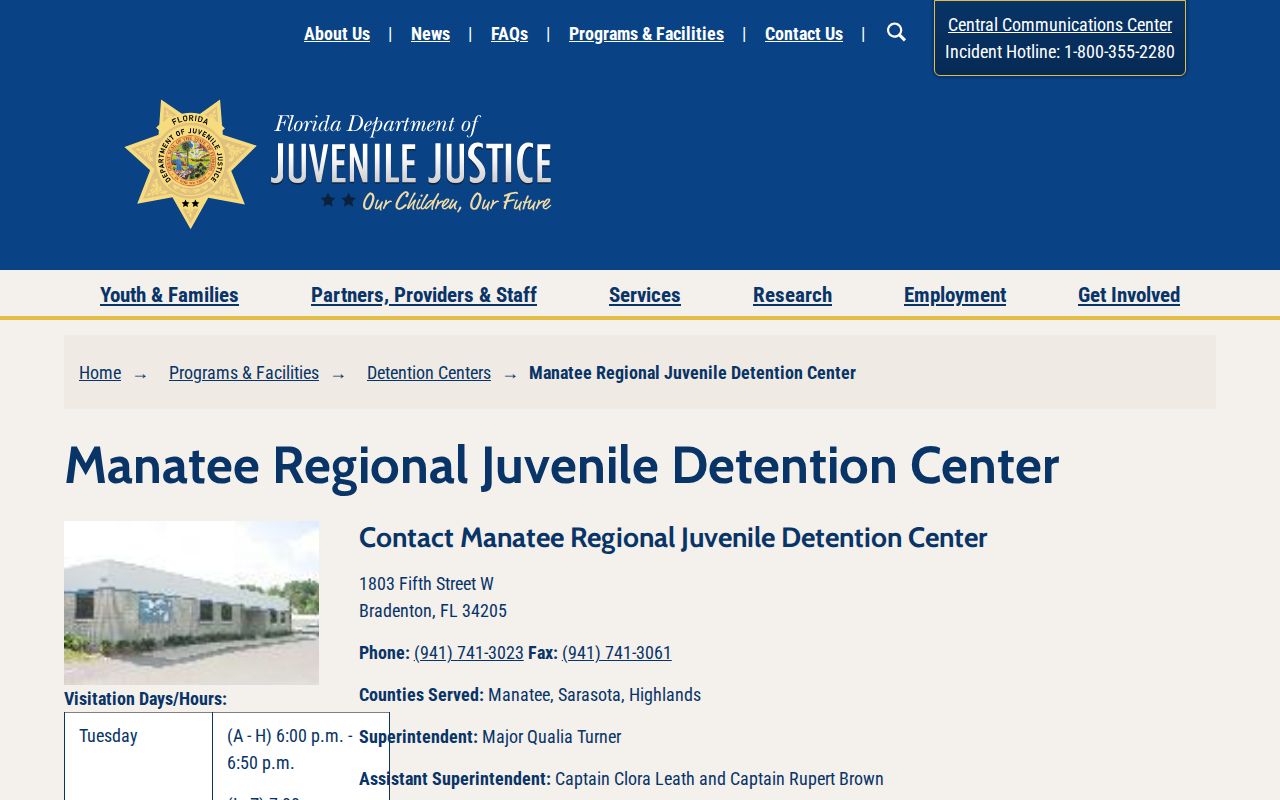
The public page confirms facility-level facts. It does not expose a youth roster, release list, booking photo gallery, or open case history.
Manatee Juvenile Community Supervision
When a youth leaves secure detention for probation, home detention, diversion, aftercare, or service navigation, the Manatee County DJJ Probation and Community Intervention office is the local youth-specific route. It is not the same as FDC adult community supervision. The correct office can help an authorized person understand who manages the next phase and which conditions or services apply.
Manatee County DJJ Probation and Community Intervention302 Manatee Avenue East, Suite 100
Bradenton, FL
Phone: 941-527-4770
Services: screening, diversion, probation, aftercare, and service navigation
The DJJ Manatee probation page documents this local community-intervention channel.
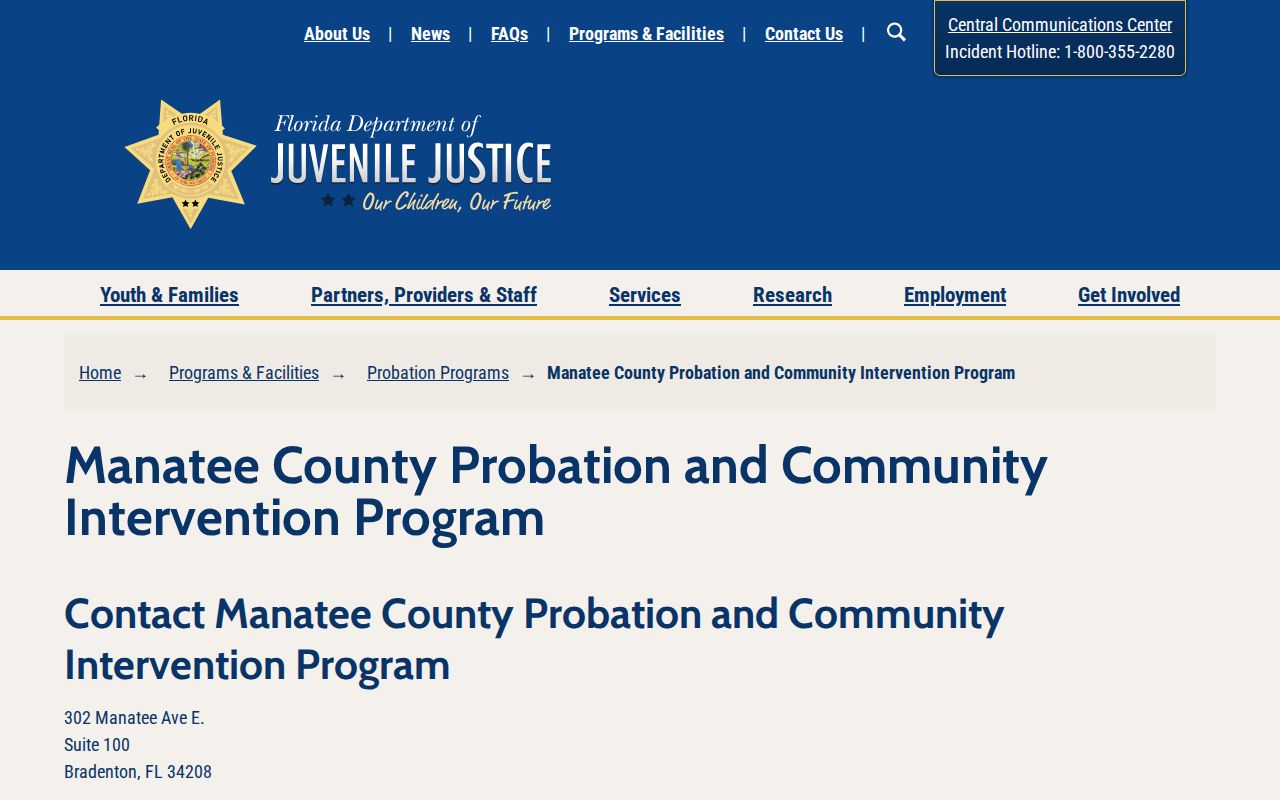
This office is the appropriate local follow-through for eligible youth cases after secure detention or residential placement, within confidentiality and authorization rules.
Manatee Juvenile Center Role
DJJ identifies Manatee Regional Juvenile Detention Center as a 60-bed secure center serving Manatee, Sarasota, and Highlands counties. It reports an approximately 14-day average secure-detention stay. Those figures describe the facility as a whole. They do not predict one youth’s release date, and they do not mean every youth follows a two-week path. Court dates, risk decisions, placement availability, and case-specific orders control each case.
The regional service area is another reason to verify the court and assigned case office. A youth held in Bradenton may have a case or community destination tied to Sarasota or Highlands County. Facility location alone does not establish the home county, court venue, or supervision office. Ask the authorized case contact which jurisdiction now controls.
The adult Manatee County Central Jail is a separate MCSO facility with a public recent-release inquiry. Its access rules must not be copied onto the juvenile center.
Manatee Youth Release Records
A juvenile release question should be framed narrowly. Ask the authorized agency or court for the status or order needed, not a broad demand for all youth records. Useful identifying facts can include the youth’s full legal name, date of birth, case number if known, caregiver relationship, and the reason the requester is authorized. Do not send sensitive youth information to an unrelated adult records office.
Florida section 960.001 distributes victim-notification duties among agencies based on the custody event. DJJ, the prosecutor, court, or another official channel may control notice in a juvenile case. An automated alert should prompt direct confirmation. It does not replace a court order or authorized DJJ record.
Possible records include a detention order, release order, home-detention conditions, probation disposition, or residential-placement order. Availability varies with confidentiality and the requester’s role. If an exception permits public access, the custodian can still redact protected facts. Ask for the legal basis when access is denied, but do not assume that Florida’s broad adult public-record practice overrides section 985.04.
Manatee Youth Facility Boundaries
Archived references can cause wrong routing. Palmetto Youth Academy at 14494 Harlee Road appears in older DJJ reporting, while county capital planning describes acquisition of that building for Sheriff use. It should be treated as former or archived, not as a current youth release destination. Historical references to Bradenton Bridge likewise do not establish a current DJJ detention route.
The current Facility Map contains two active entries: the adult Central Jail and the DJJ-operated regional juvenile center. They have separate operators, populations, records, and release paths. The Manatee County release-search hub covers the adult county, state, federal, and immigration routes. Youth-specific questions remain with DJJ and the juvenile court because confidentiality and placement rules make an open adult-style search unsuitable.
A move between youth programs should also be described with care. Leaving secure detention for a residential commitment is a placement transfer, not a return home. Home detention or probation can place the youth in the community while a DJJ officer and court order still control the case. Return to a parent or guardian ends the secure detention stay, but it does not by itself close the juvenile case. The authorized court order and assigned DJJ contact show which of those paths applies.
Note: An archived facility name in an old report does not prove current custody, release, or placement at that location.