
Manatee Projected Versus Actual Release
Florida law calls the state-prison forecast a tentative release date. The FDC public interface may instead display Current Release Date. Both terms describe a calculation made before the person leaves. An actual release date is historical proof that the correctional episode ended. A predicted date can move, while an actual event should be read with the release type and destination.
Pretrial detention works differently. Bond, first appearance, a court order, case disposition, warrants, and holds control when a detainee may leave Manatee County Central Jail. No sentence has yet supplied a good-time calculation. A transfer also closes one booking without sending the person into the community. The receiving system must be checked.
A maximum sentence expiration date is not always the same as the tentative date. The maximum date begins with the imposed term and lawful credit. The tentative date reflects gain-time awarded or lost under the governing rules. On an active record, preserve the exact label and date shown. After release, move to the historical record rather than citing an old forecast.
Find Manatee Projected Release Dates
Start with the custody level. The FDC inmate-population search is the state-prison path. Its full file refreshes weekly, while location and release-date changes update nightly. The separate Inmate Release Information Search covers people released or scheduled for release and also updates nightly.
- Confirm whether the person is in Manatee county custody or FDC state custody.
- For an FDC prisoner, search by the six-character DC number when known. Otherwise use first and last name and compare identity fields.
- Open the record and read the exact live label for the forecast, such as Current Release Date. Review sentence and incarceration history.
- For a county sentence, obtain the judgment, jail credit, and sentence terms from the Manatee Clerk, then ask MCSO for its computed date and local good-time treatment.
- For a pretrial booking, follow bond and court events instead of trying to calculate a sentence date.
The active-inmate form appears at the official FDC source.
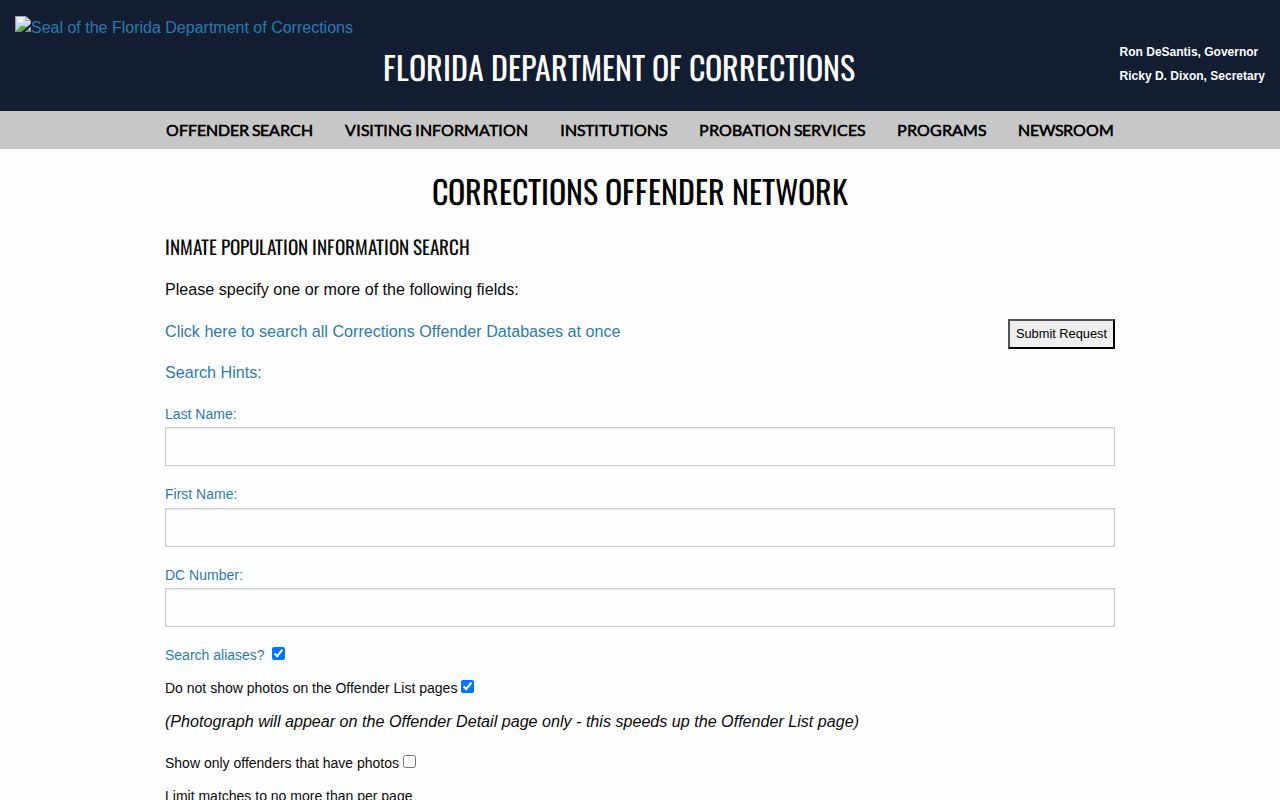
The form leads to state-prison records. It does not calculate an ordinary Manatee County jail sentence or predict a pretrial release.
The released-first FDC search accepts last name, first name, a six-character DC number, and an aliases option. Name searches work as prefixes, so the DC number is the strongest match. A detail page may show identity, Custody, Release Date, current prison sentence history, and incarceration dates. Use the Clerk docket for exact legal charge wording because FDC descriptions can be shortened.
Florida State Release Calculations
Under Florida Statutes section 944.275, FDC first establishes a maximum sentence expiration date from the imposed term or combined terms, less lawful credit. It then establishes a tentative release date based on gain-time granted or forfeited. Gain-time is credit that may reduce time served under the statute. It is not a promise that every listed day will remain available.
For offenses committed on or after October 1, 1995, incentive gain-time can reach ten days per month. Section 944.275(4)(f) still prevents an award that would release the person before at least 85 percent of the imposed sentence has been served. Court-awarded physical custody credit counts toward that floor. Some serious offenses have added limits, life sentences remain life absent pardon or clemency, and gain-time may be lost after an infraction.
Historical tiers complicate older records. Basic gain-time applies only to a defined 1978 through 1993 offense period. Incentive maximums also differ for pre-1994 offenses and the 1994 through September 1995 period. Consecutive or concurrent terms, mandatory minimums, credits, forfeitures, and later court orders can all alter the result. A simple web calculator cannot safely reproduce the official computation.
The governing text is visible at the Florida Legislature source.
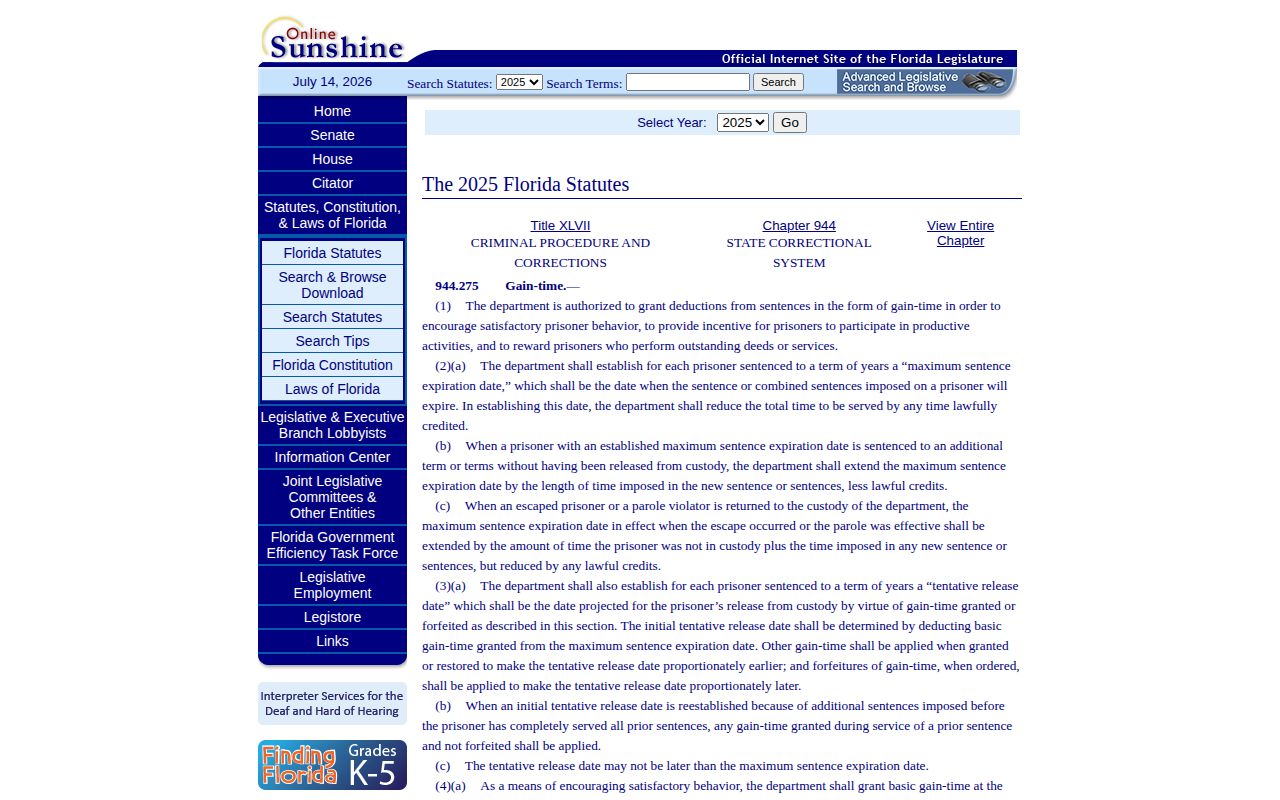
The statute supplies the state-prison framework, but the official FDC record supplies the person-specific calculation.
Why Manatee Release Dates Change
A change does not always signal an error. FDC recalculates when a legal or correctional input changes. County jail staff may also receive a later order, identify another warrant, or correct the credit applied to a sentence. Compare the newest record with the prior value and ask the calculating office for the basis when the difference matters.
| Factor | Possible effect | Best source |
|---|---|---|
| Gain-time award | May move a tentative state date earlier within legal limits | FDC sentence record |
| Gain-time forfeiture | May move the forecast later after discipline | FDC classification record |
| Jail or prison credit | Changes time left on the sentence | Judgment, credit order, and custodian calculation |
| New court order | May amend, vacate, or restructure the sentence | Manatee Clerk docket |
| Warrant or detainer | May prevent community release despite the end of one term | Holding and receiving agencies |
| Parole or Commission action | May establish, change, deny, rescind, or revoke an effective date | Final FCOR order |
Note: A transfer date ends custody for one agency but is not proof that the person left all confinement.
Confirm Manatee Release Dates
For an FDC sentence, compare the active inmate record with the released-person record after the forecast passes. The release detail can include Custody, Release Date, sentence history, and Date In-Custody and Date Out-Custody rows. Questions may be directed to the FDC Bureau of Admission and Release at 850-488-9167 or dc.release@fdc.myflorida.com.
For a county term, request the actual release date and release or transfer disposition from MCSO. Compare that record with the Manatee Clerk judgment, sentence, and jail-credit entries. Florida VINE can send a custody-change alert, but it is not a certified release sheet. Registration steps and feed limits are explained on the VINELink Inmate Search page.
If the online FDC record is incomplete, use the FDC public-records route and identify the person by name and DC number. Request the admission/release record, calculation history, actual date and type, and relevant incarceration history.
Manatee County Has Another Clock
Florida uses different laws for state prison and county jail. Section 944.275 and its 85-percent floor govern the state framework described above. A Manatee County jail term instead falls under section 951.21, subject to local implementation. Applying the FDC state formula to a Central Jail sentence would be a substantive error.
Section 951.21 authorizes county good-conduct commutation unless the county commission discontinues or revises it. The statute sets potential monthly amounts by years served, allows an added award on the sheriff or warden's recommendation, and permits forfeiture for misconduct. Section 921.161 separately requires credit for county jail time before sentence.
Those statutes do not establish the answer for a named person by themselves. Ask MCSO and the Clerk for the imposed sentence, jail credit, computed release date, and the local good-time rule actually used. This state-versus-county split is the key Manatee release-date distinction.
Section 951.21 describes possible county good-conduct amounts by years served. It permits up to five days per month during the first two years, ten days per month in years three and four, and fifteen days per month in later years. It also permits an added award of up to five days per month on recommendation and allows forfeiture for misconduct. Local adoption and the specific sentence still control, so these numbers must not be dropped into a stand-alone calculator.
Manatee Pretrial Release Timing
A pretrial detainee ordinarily has no fixed projected release date. Someone may leave after bond, recognizance, a first-appearance ruling, dismissal, or another court order. Supervised recognizance screening can take more time, and another warrant or hold can block a walkout even after the local court authorizes release.
Use the Sheriff booking record to confirm when that booking ended. Use the Clerk docket to learn what the judge ordered and what happened to the case. If the record says transfer, follow the receiving agency. For a fuller named-person lookup across these systems, use the Manatee County released-inmate search.
Request Manatee Release Calculations
An online result can omit the calculation history. For a state sentence, identify the name and DC number and ask FDC for admission and release records, the current calculated date, relevant credit, incarceration history, and the actual release type when the event occurs. FDC Classification and Central Records lists 850-488-9859 and central.classification@fdc.myflorida.com. The Bureau of Admission and Release handles release-record questions.
For a county sentence, use the MCSO Public Records Center or Records Section and make the request narrow. Include the full name, birth date if known, booking number, sentence date, and approximate release period. Ask for the booking sheet, computed release date, actual release date and type, release authorization, and transfer destination if applicable. State that electronic delivery is acceptable.
The official FDC public-records page shows the state request route.
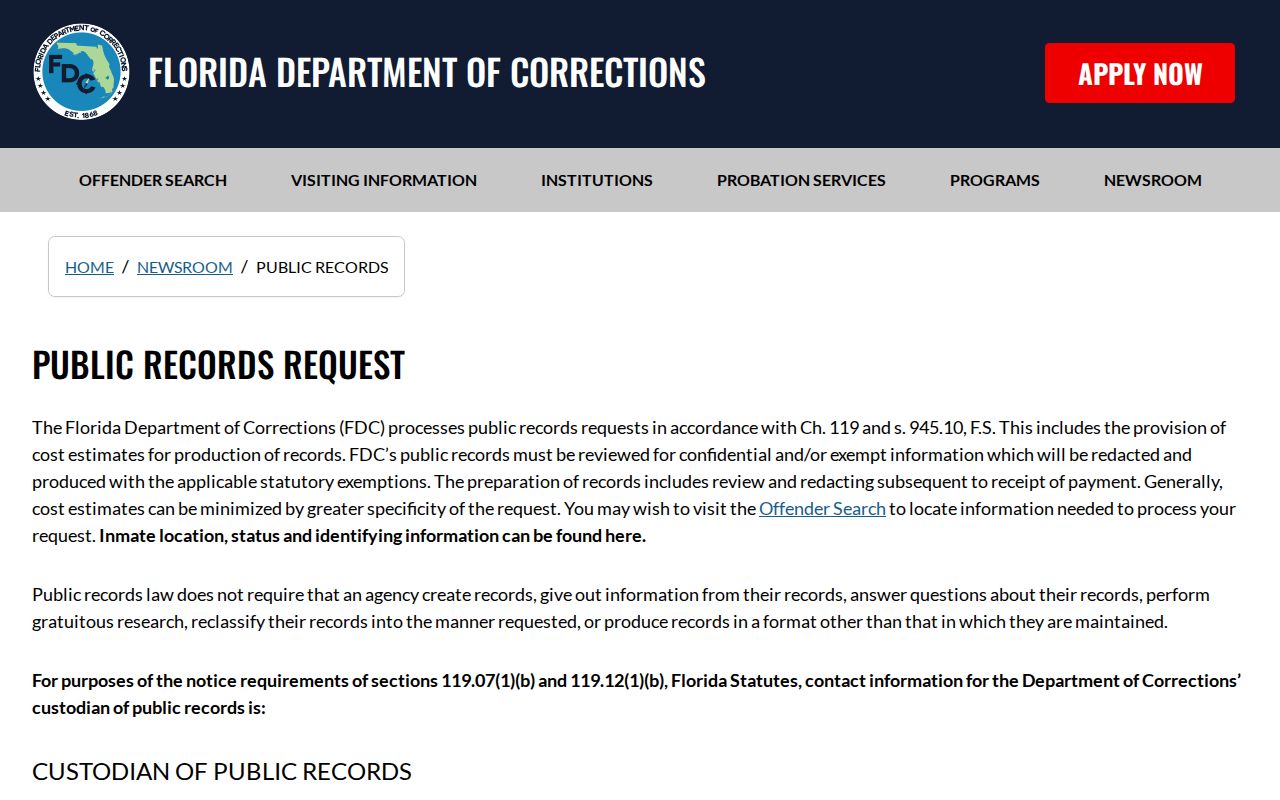
A records response can explain a person-specific date more reliably than an unofficial estimate built from the sentence alone.
Manatee Release and Supervision Dates
Leaving prison does not always end state oversight. After an FDC release, search the separate supervised-population database for probation, parole, conditional release, community control, or another supervision term. A supervision termination date is not the prison release date. Each marks a different event.
Parole decisions also require care. An FCOR agenda proves that a matter was scheduled, not that parole was granted or that an effective date became final. Ask for the Commission's final action or order when parole affects the forecast. A later revocation, rescission, or court order can alter the path again.
Probation and conditional release dates should also be kept separate from custody dates. FDC's community-supervision search can show supervision type, status, office, offense or case data, and supervision dates. A person may be out of prison while still under an active term. Conversely, a probation record can exist without a prior state-prison stay.
To confirm the full sequence, place the events in order: sentence, custody credit, calculated release, actual release or transfer, start of supervision, and final discharge. Each event may come from a different source. The chain is more reliable than treating the first date found as the answer to every release question.
Record the date on which each portal was checked. FDC data can change after a nightly release-date update, while a court order may post on a different schedule. A dated copy makes later reconciliation much easier.